Translate

Mostrando entradas con la etiqueta Geography. Mostrar todas las entradas

viernes, 5 de abril de 2013

Rivers in England


The main rivers are Thames, Severn, the Trent and the Ouse.
The Thames is the principal river of England. It rises near Kemble and passes through the cities of Oxford, Wallingford, Reading, Henley-on-Thames, Marlow, Maidenhead, Eton, Windsor and London. Its length is 346 km and flows into the channel Mancha.Es a navigable river, connecting London with the sea on one side and the dense network of inland canals on the other. The most important is the Bristol Channel, which communicates with the River Severn. Its main tributaries are the rivers Churn, Leach, Cole, Coln, Windrush, Evenlode, Cherwell, Ock, Thame, Pang, Kennet, Loddon, Colne, Wey and Mole.
The River Severn is the longest river in the United Kingdom and. It has 354 km in length. The river rises near Plynlimon, and through towns like Shrewsbury, Worcester and Gloucester. It flows into the Atlantic Ocean forming an estuary in the Southwest. Its main tributary is the River Tern, but also his own tributaries the rivers Vyrnwy, Stour, Warwickshire Avon and Bristol Avon and Teme the left and the right Wye.
The River Trent has a length of 297 km. Born in Staffordshire between Biddulph and Mow Cop and flows into the North Sea in the Humber estuary, which it shares with the River Ouse. It falls on the estuary at Niagara Trent. It is a navigable river in the 188 km that between Burton and the mouth. Its main tributaries are the rivers Dove, Derwent, Erewash and Devon to the left, and Mease, Tame and Soar to the right. Traverses the cities of Stoke-on-Trent, Derby, Nottingham, Newark-on-Trent, Immingham and Hull.
The River Ouse has a length of 240 km. Born around the villages of Syresham and Sulgrave, in Northamptonshire. Traverses the cities of Brackley, Buckingham, Stony Stratford Milton Keynes, Newport Pagnell, Olney, Bedford, St Neots, Godmanchester, Huntingdon, St Ives, Littleport and Downham Market. Flows into the North Sea in the Humber estuary, which it shares with the River Trent. Its main tributaries are the Babingley, Gaywood, Ouzel or Lovat, Odell Rill, Kym, Ivel, Cam, Lark, Ouse and Wissey.

miércoles, 28 de noviembre de 2012

Brighton


Brighton  is the major part of the city and unitary authority of Brighton and Hove (formed from the previous towns of Brighton, Hove, Portslade and several other villages) on the south coast of Great Britain. Formerly part of the non-metropolitan county of East Sussex, it remains part of the ceremonial county of East Sussex, within the historic county of Sussex.
The ancient settlement of Brighthelmstone dates from before Domesday Book (1086), but it emerged as a health resort featuring sea bathing during the 18th century and became a destination for day-trippers from London after the arrival of the railway in 1841.

Interesting places


The Royal Pavilion
The Royal Pavilion is a former royal residence located in Brighton, England. It was built in three campaigns, beginning in 1787, as a seaside retreat for George, Prince of Wales, from 1811 Prince Regent. It is often referred to as the Brighton Pavilion. It is built in the Indo-Saracenic style prevalent in India for most of the 19th century, with the most extravagant chinoiserie interiors ever executed in the British Isles.


Grand Hotel


The hotel was designed by architect John Whichcord Jr., and built in 1864 on the site occupied previously by a battery house. It was originally built for members of the upper classes visiting Brighton and remains one of the most expensive hotels in the town. Among its advanced engineering features at the time was the "Vertical Omnibus", ahydraulically powered lift powered by cisterns in the roof. This was the first lift built in the United Kingdom outside London, where only two others had been installed. The building itself is an example of Italian influence in Victorian architecture.

There are 201 rooms in the hotel, including 8 singles, 115 standard twin and standard double rooms, 31 sea-view twin and sea-view double rooms, 42 "sea-view deluxe" rooms and 4 sea-view suites, including the "Presidential Suite". It offers bespoke conferencing facilities for up to 800 guests. The largest room is the Empress Suite, which has a capacity of 800 guests. It is commonly used as a matrimonial venue for weddings. The hotel's 43ft yacht, the AnnabelOlivia, can be used for corporate functions. It was awarded 5 star status in 1988.


Brighton Wheel


 The Brighton Wheel, also known during its planning and construction phase as theBrighton O and the Wheel of Excellence, is a transportable Ferris wheel installation erected in October 2011 on the seafront in Brighton, part of the English city of Brighton and Hove. It has planning permission to remain in place until 2016. Situated below the East Cliff near Brighton Pier and built with private funding, its promoters anticipate that several hundred thousand visitors per year will experience the 12-minute ride. The wheel's location in a conservation area with many residential buildings has proved controversial.


St Nicholas' Church

The Church of Saint Nicholas of Myra, usually known as St. Nicholas Church, is an Anglican church in Brighton. It is both the original parish church of Brighton and the oldest surviving building in Brighton. It is located on high ground at the junction of Church Street and Dyke Road in the city centre, very close to the main shopping areas. Due to its architectural significance the church is a Grade II* listed building.

The ancient Southover Priory in Lewes was responsible for the church from the end of the 11th century until 1537, when the last prior surrendered it to the Crown. In 1540, it passed to Thomas Cromwell, 1st Earl of Essex; in 1541, following his death by execution in July 1540, the advowson was granted to Anne of Cleves; and finally, in 1558, the Bishop of Chichester gained it. The holder of that title has been the patron of the church ever since.


The Brighton Beach

The seafront has bars, restaurants, nightclubs and amusement arcades, principally between the piers. Being less than an hour from London by train has made the city a popular destination, especially with big party groups. Brighton beach has a nudist area.
Brighton's beach, which is a shingle beach up to the mean low tide mark, has been awarded a blue flag. The Monarch's Waylong-distance footpath heads west along the seafront above the beach.

miércoles, 21 de noviembre de 2012

Mountains and saws of England


Dorset Downs
The Dorset Downs constitutes an area of hills of chalk in the center of Dorset's county.
The principal activities in the field include the agriculture on arable lands; in addition there are important extensions of forests and of calcareous meadows. The formation is presented great by phreatic napa that acts as reservoir of drinkable water, supplied from there to great part of the county. Beside allowing the existence of the above mentioned reservoirs, the properties of the chalk favor the appearance of seasonal rivers, which depends on the levels of the underground water.

Glastonbury Tor
Glastonbury Tor is a hill in Glastonbury, in Somerset Crowned by a building without roof: the Tower of San Miguel. The zone is controlled by the National Trust. Tor is a word of Celtic origin that means " conical hill ". This this hill positioned in half of a plain known as Summerland Meadows and surrounded by the Rio Brue. In 1892 there were identified the remains of a former villa that dates back to the Age of Iron. Later there are indications of Roman occupation. The britanos it knew her as Ynys yr Afalon For what it is believed that it might be the Avalon of the legendary King Arturo.


Sca Fell
The Sca Fell is the highest second mountain of England with 964 meters after the Scafell Pike from which it is separated by Mickledore's step. It is placed inside the National Park of the District of the Lagos.
Scafell Pike
The Scafell Pike is the highest mountain of England with 978 meters on the level of the sea. It is placed in Cumbria's county inside the National Park of the District of the Lagos. Sometimes it is confused with a neighboring mountain called Sca Fell, from which it is separated by Mickledore's step.

South Dorset Downs
South Dorset Downs or Purbeck Hills are a formation of chalk located in Dorset. In Durlston Head, the chalk that one finds behind they begin to show signs of erosion, thanks to which there were formed Poole's bay and Solent's strait.
The height of the formation and his proximity to Poole's port and to the southern coast they have cost him to the hills a considerable strategic importance. There exist in addition several archaeological deposits of the age of Roman and Anglo-Saxon iron and of the periods.

domingo, 4 de noviembre de 2012

The river Thames

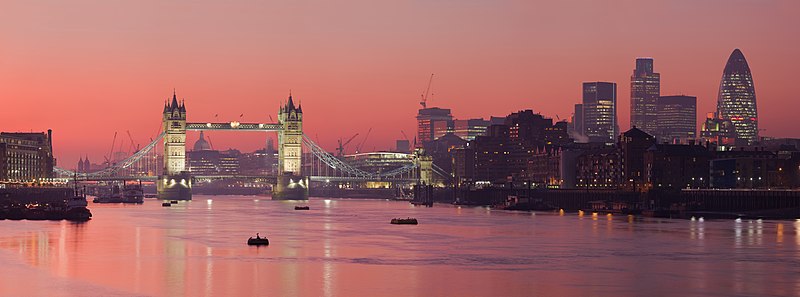
The river Thames is a river of the south of England. It is born in elcondado of Gloucestershire, Kemble's locality, then constant for Oxford, Wallingford, Reading, Henley-on-Thames, Marlow, Maidenhead, Eton, Windsor and London and ends in the sea of the North. It possesses islands along the river they are known like ait, for example.
During the Pleistocene, the primitive river Thames was flowing from Wales up to Clacton-on-Sea, crossing what at present is the North Sea to end up by being a tributary of the Rhine. This course was blocked by a mass of ice during the Age of Ice. The river turned aside up to taking his current course, coming up to the one that is today the city of London.
During the XVIth and XVIIth century, the river was one of the principal means of transport between London and Westminster. From the 19th century the river started contaminating. At the end of this century until middle of the 20th century, a massive cleanliness of the Thames was realized. At present it is one of the cleanest rivers of those who flow across a great city.
His length is 346 km.
This one is a documentary about the river Thames:
http://www.youtube.com/watch?v=5tlKvPCM_FI

domingo, 28 de octubre de 2012

Fauna

The island of Great Britain, together with the rest of the archipelago known as the British Isles, has a great moderate environment.
The environment and the ecology is also very young due to the appearance of an Age of Ice, which means that it has been very much less time to develop this diversity.  
The seasonal changes that take place in the whole country it means that the plants have to face to many changes linked to the levels of solar light.
From middle of the 18th century, Great Britain has happened for the industrialization and the increasing urbanization. A study of 2006 suggested that 100 species have become extinct in the United Kingdom during the 20th century.
The most common fauna in inglaterra is: 
Wolves, bears, reindeers, foxes, hedgehogs hares, rabbits, weasels, ermines, shrews, rates, mice, otters and seals. There are few amphibians and reptiles. 
In addition there is a great number of birds as: 
Pheasants, partridges, red grouses...