Translate

martes, 23 de abril de 2013

Science in England


From England comes Prominent Figures of the Sphere of Science and Mathematics, as Isaac Newton, Michael Faraday, Robert Hooke, Robert Boyle, Joseph Priestley, JJ Thomson, Charles Babbage, Charles Darwin, Stephen Hawking, Christopher Wren, Alan Turing, Francis Crick, Joseph Lister, Tim Berners-Lee, Andrew Wiles and Richard Dawkins.
Some Experts Say That The First UN idea Metric WAS invented by John Wilkins, the first secretary of the Royal Society in 1668.
As the birthplace of the Industrial Revolution, England was home many Important Inventors version of the late 18th and Principles 19.
The British engineer Isambard Kingdom Brunel, WAS Known For The Creation of the Great Western Railway, a series Famous Steamboats, and numerous bridges Important release, revolutionized the Public Transportation and Engineering today.
Some of the Inventions and Discoveries made many English child portion: The First Industrial machine spinning, The First Team and the Modern Computer, the World Wide Web along with HTTP and HTML, The Results of the first blood transfusion, vacuuming, Lawn mower, Safety belt, the hovercraft, the electric motor, Microphone and steam engines.
Theories As Darwinian theory of evolution and atomic theory.
Newton WAS the enacting of universal gravitation and Newtonian mechanics, and infinitesimal calculus, WHILE That Robert Hooke Hooke's law enacting of Elasticity.
Other inventions were the railway board, heating, asphalt, rubber, the mousetrap, "cat's eye" road safety device, joint development of the light bulb, steam locomotives, the planter, and motor reaction many Modern Techniques and technologies used in precision engineering.

sábado, 20 de abril de 2013

The War of the Roses


The War of the Roses (1455-1485) was the set of conflicts intermittent civil war between the House of Lancaster wing against the House of York. Both royal families had a common origin in the Royal House of Plantagenet, as descendants of King Edward III. The name "War of the Roses" was not used at the time, but comes from the emblems of the two royal houses. On one side was the red rose of Lancaster and the white rose of another York, which were used as emblems in the war.
The war was mainly between members of the landed aristocracy and armies of feudal lords. Support for each of the sides depended largely dynastic marriages among the nobility. The patriarch of the house of Lancaster, John of Gaunt had the first title the Earl of Richmond, the same that would show Henry VII at the end of the war. The leader of the House of York was Edmund of Langley, who held the Lordship of Cambridge. Later, during the reigns of the Tudors and the Stuarts, Richmondshire and Cambridgeshire would become major foci of recusants and Puritans, respectively. Notably, the fight between factions continued beyond the time of Henry, as the monarchs that followed prompted clashes continued.
The War of the Roses, largely caused the fall of the Plantagenets, as it produced a high number of deaths among the nobility, and generate widespread social discontent. This period marked the decline of British influence in Europe, the weakening of the feudal power of the nobles and, in return, increased influence by traders, and the growth and strengthening of a centralized monarchy under the Tudors . This war marks the end of the English feudal era and the beginning of the Renaissance.
This last rose is the Tudor rose, created at the end of the civil war, uniting both emblems.

domingo, 14 de abril de 2013

Margaret Thatcher Dies at 87

London, England (09/ABR/2013.)
It was an admired woman in the world, but also hated. The former Conservative prime minister Margaret Thatcher, who transformed and divided with the same depth to his country, died

The so-called "Iron Lady" died "peacefully" at the Ritz hotel room in London, where he lived temporarily, his spokesman said Lord Tim Bell.
Worldwide leaders expressed dismay at the demise of the so far only head of the British Government.
In the UK, hundreds of people gathered in the city of Glasgow, Scotland, and in London's Brixton neighborhood to celebrate the death, as the economic policy of the premier hit with more taxes to the British.
Thatcher had a great friendship with Ronald Reagan, U.S. president of the time. The same happened with former Chilean dictator Augusto Pinochet, who also supported his campaign as she herself admitted in the late nineties.
The military supported the British premier in the war against Argentina over the Falklands dispute.
In Buenos Aires, the Government issued an official reaction, but citizens criticized on Twitter, blaming her for the death of 649 soldiers in the South Atlantic conflict.
Thatcher ordered the British landing in 1982 in the Falkland Islands, located about five thousand miles-UK military to evict the Argentines who had "occupied".
"She will always be remembered in the islands for his decision to send our forces who liberated Argentina home after the invasion in 1982".

in London as a result of a stroke at age 87.

viernes, 5 de abril de 2013

Rivers in England


The main rivers are Thames, Severn, the Trent and the Ouse.
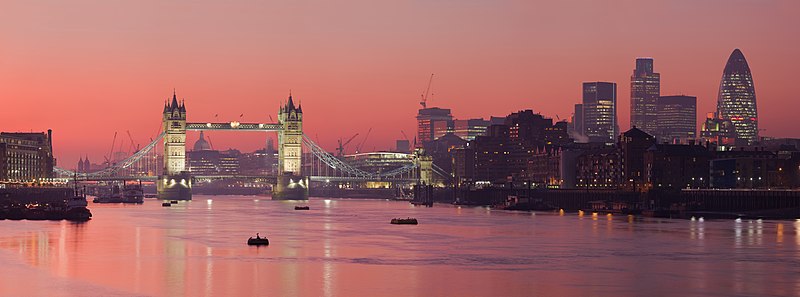
The Thames is the principal river of England. It rises near Kemble and passes through the cities of Oxford, Wallingford, Reading, Henley-on-Thames, Marlow, Maidenhead, Eton, Windsor and London. Its length is 346 km and flows into the channel Mancha.Es a navigable river, connecting London with the sea on one side and the dense network of inland canals on the other. The most important is the Bristol Channel, which communicates with the River Severn. Its main tributaries are the rivers Churn, Leach, Cole, Coln, Windrush, Evenlode, Cherwell, Ock, Thame, Pang, Kennet, Loddon, Colne, Wey and Mole.
The River Severn is the longest river in the United Kingdom and. It has 354 km in length. The river rises near Plynlimon, and through towns like Shrewsbury, Worcester and Gloucester. It flows into the Atlantic Ocean forming an estuary in the Southwest. Its main tributary is the River Tern, but also his own tributaries the rivers Vyrnwy, Stour, Warwickshire Avon and Bristol Avon and Teme the left and the right Wye.
The River Trent has a length of 297 km. Born in Staffordshire between Biddulph and Mow Cop and flows into the North Sea in the Humber estuary, which it shares with the River Ouse. It falls on the estuary at Niagara Trent. It is a navigable river in the 188 km that between Burton and the mouth. Its main tributaries are the rivers Dove, Derwent, Erewash and Devon to the left, and Mease, Tame and Soar to the right. Traverses the cities of Stoke-on-Trent, Derby, Nottingham, Newark-on-Trent, Immingham and Hull.
The River Ouse has a length of 240 km. Born around the villages of Syresham and Sulgrave, in Northamptonshire. Traverses the cities of Brackley, Buckingham, Stony Stratford Milton Keynes, Newport Pagnell, Olney, Bedford, St Neots, Godmanchester, Huntingdon, St Ives, Littleport and Downham Market. Flows into the North Sea in the Humber estuary, which it shares with the River Trent. Its main tributaries are the Babingley, Gaywood, Ouzel or Lovat, Odell Rill, Kym, Ivel, Cam, Lark, Ouse and Wissey.

viernes, 29 de marzo de 2013

Lake District

The National Park Lake District covers the North West of England and was created in 1951 to protect the landscape against unwanted change that industry and trade could cause.

Almost all the land in the park is privately owned, with small areas belonging to the National Trust. Generally in England there is no restriction on the entry or movement within the park.
The highest mountains in England are within the park boundaries. It is considered an area of outstanding natural beauty with breathtaking scenery unique to this corner of England.
The farmland, hills and towns add aesthetic value to the landscape with an ecology modified by human influence for millennia, and hosting important wildlife habitats.
The Lake District is intimately associated with English literature of the eighteenth and nineteenth centuries. Thomas Gray was the first to bring attention to the region, when he wrote a journal of his Grand Tour in 1769, but it was William Wordsworth who wrote poems most famous and influential. Wordsworth's poem "I Wandered Lonely as a Cloud", inspired by the sight of daffodils on the shores of Ullswater, remains one of the most famous of the English language. The area was known as the Lake Poets.
During the twentieth century, the children's book author Beatrix Potter wrote many of her famous Peter Rabbit books in the Lake District from his home in Hill Top Farm.
This is a documentary of William Wordsworth and the Lake District:

jueves, 28 de marzo de 2013

Literature, poetry and philosophy in England


The period of Old English literature was always backed by the epic poem Beowulf, the secular prose of the Anglo-Saxon Chronicle is, along with Christian writings Judith, Caedmon's Hymn and hagiographies holy. After the Norman conquest Latin continued amongst the educated classes, as well as an Anglo-Norman literature. English literature emerged with Geoffrey Chaucer, author of The Canterbury Tales, along with Gower, the Pearl Poet and Langland. The Franciscans, William of Ockham and Roger Bacon were major philosophers of the Middle Ages and the other ages. Julian of Norwich it was with her Revelations of Divine. Love was a prominent Christian mystic. During the Renaissance, William Shakespeare was the great exponent, with works such as Hamlet, Romeo and Juliet, Macbeth and The Dream of a Summer Night, it remains one of the most championed authors in English literature. Marlowe, Spenser, Sydney, Thomas Kyd, John Donne, Jonson are other established authors of the Elizabethan age. Francis Bacon and Thomas Hobbes wrote on empiricism and materialism, including scientific method and social contract. Robert Filmer wrote about the divine right of kings. Andrew Marvell was the best known poet of the Community, while John Milton authored Paradise Lost during the Restoration it was.
Some of the most prominent philosophers of the Enlightenment were Locke, Paine, Johnson and Bentham. More radical elements were later countered by Edmund Burke who is regarded as the founder of conservatism. The poet Alexander Pope with his satirical verses, became well regarded. The English performance is a significant role in romanticism, Coleridge, Byron, Keats, Shelley, Shelley, Blake and Wordsworth were major figures. In response to the Industrial Revolution, the writers seemed to find a way between liberty and tradition; Cobbett, Chesterton and Belloc were main exponents Penty and cooperative movement advocate Cole. Empiricism continued through Mill and Russell, while Williams was involved in the analysis. The authors of the era of the Victorian era include Dickens, the Brontë sisters, Jane Austen, Eliot, Kipling, Hardy, H. G. Wells, Lewis Carroll and Evelyn Underhill. Since then England continued to produce novelists such as C. S. Lewis, Orwell, D. H. Lawrence, Virginia Woolf, Enid Blyton, Huxley, Christie, Pratchett, J. R. R. Tolkien, and J. K. Rowling.

sábado, 16 de marzo de 2013

Thirteen bodies are discovered at the time of the Black Death


Excavations of a rail project have enabled the discovery in London of thirteen bodies and remains of pottery dating from the mid-fourteenth century and which seem to belong to the time of the Black Death. It was already known that in that area there was a cemetery but its exact location was a mystery.
The skeletons were found in Charterhouse Square Square, along with ceramic mid-fourteenth century, during excavations as part of the Crossrail project, the new line of high-speed subway linking the districts of East and West London.
DNA tests to be conducted on human remains could provide valuable information about the development of the bacteria that caused the Black Death call or Black Death, the most devastating plague in human history that affected Europe in the nineteenth XIV and peaked between 1347 and 1353.
During the excavation works teams have discovered skeletons near London's Liverpool Street (north of town), remains of the Bronze Age and the largest piece of amber found in the UK.
"We have found archaeological remains practically all periods, from prehistory to the twentieth century, but this location is probably the most important medieval site of those found," said Jay Carver, the rail project archaeologist.
The bodies were distributed in two rows, before the black plague became epidemic causing mass graves. Archaeologists working on the Crossrail project and others from the Museum of London will continue digging to discover more remains or other findings.
The Crossrail project is presented as the most ambitious in Europe and also includes the construction of two large tunnels 30 meters below the surface. If all goes as planned, the project of uniting over 118 km the towns of Maidenhead, west of London, in the county of Berkshire, with Shenfield (Essex), to the east, will be completed in 2017 . The Crossrail will operate up to 24 trains at peak times, each traveling at speeds up to 160 km / h.

miércoles, 13 de marzo de 2013

A Van Dyck is discovered stored in an English museum


A passionate British art has identified a valuable online see Van Dyck was stored for years in an English museum because they thought it was a copy.
The art historian Bendor Grosvenor authorship certified female portrait, 72 by 61 inches, after seeing it on the website "Your paintings" enabled by public broadcaster BBC to catalog all the oils in the hands of public institutions in the UK.
A Grosvenor not had no doubt that the portrait of Olivia Boteler Porter, bridesmaid Henrietta Maria, wife of King Charles I, was the Flemish painter Anthony Van Dyck, who worked at the court of the monarch.
The work, in the 1630s, remained for years forgotten and dusty Bowes Museum in County Durham English because it was believed to be a copy.
Grosvenor has valued the portrait, which will continue in public hands, around one million pounds (1.1 million euros or 1.5 million), compared to the four or five thousand pounds (four thousand to five thousand 588 euros or 735 995 five thousand to seven thousand 493 U.S. dollars) worth is estimated as the alleged copy.
The picture identification process detailed in the BBC program "Culture Show", which will air today and the Bowes Museum director, Adrian Jenkins, thanks Grosvenor to have increased the pedigree of his collection.